TABLE OF CONTENTS
Overview
The Stack Internal MCP Server allows you to connect your AI coding agents to your organization's verified knowledge base. It provides structured, secure read and write access to your team's content so agents can search your Stack Internal site before falling back to generic knowledge. The MCP server enables AI coding agents, AI assistants, and custom agents to:
- Read trusted, high-quality enterprise knowledge to improve their outputs.
- Capture, draft, create, and edit questions, answers, and articles from within their own interface, seamlessly storing enterprise knowledge back to your Stack Internal site.
We're providing this feature as a free trial for a limited time. If you wish to continue using the MCP server, have your site administrator reach out to their Stack Overflow account representative.
To learn more about the inner workings of the Stack Internal MCP server, read the MCP Server Architecture article.
MCP Server landing page
To access documentation, one-click installs, agent connection example code, tools, prompts, and more, go to https://[your_site].stackenterprise.co/mcp.
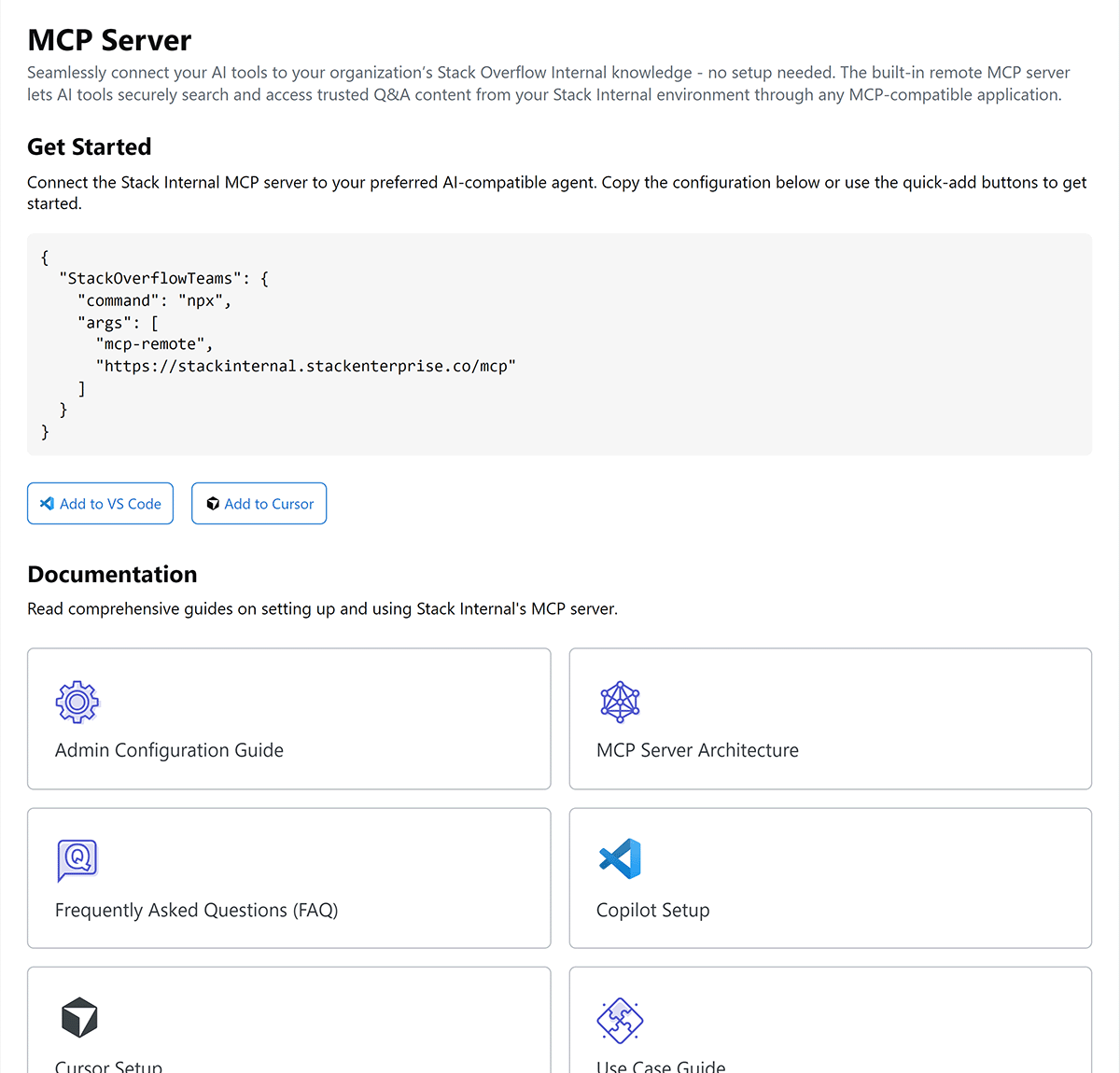
JSON connection code
You can connect to any MCP-compatible client using the following JSON:
{
  "mcpServers": {
    "stack-internal": {
      "url": "https://[your_site].stackenterprise.co/mcp",
      "headers": {}
    }
  }
}
Claude Code
claude mcp add --transport http stack-internal https://[slug].stackenterprise.co/mcp
Claude Desktop
Edit your claude_desktop_config.json file and add the JSON connection code above.
Codex
codex mcp add stack-internal --url https://[slug].stackenterprise.co/mcp
The Stack Internal Community MCP Server uses streamable HTTP as its transport method. It does not support Server-Sent Events (SSE).
Authentication
The Stack Internal Community MCP server uses OAuth 2.0 with PKCE for secure authentication.
- You'll authenticate with your Stack Internal account. The MCP client (for example: Copilot, Cursor, JetBrains Assistant, or Claude Code) will open a browser window for login and token exchange.
- After Stack Internal Community creates a new API service application for the MCP server, admins manage client registration and API access at https://[your_site].stackenterprise.co/enterprise/api.
- Tokens are short-lived and scoped to the authenticated user. The MCP server doesn't support long-lived static tokens, so agents must refresh tokens as needed.
- The MCP server enforces security at both the user and tenant level, and logs all requests for governance and attribution.
Example connection flow (VS Code)
-
MCP client requests authorization, redirects user to Stack Internal Community login.
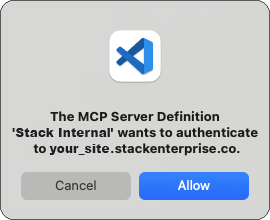
-
User signs in with SSO or Stack Internal credentials.

-
Authorization server returns a short-lived access token and refresh token.
-
MCP client exchanges the token for access to the MCP server endpoint at https://[your_site].stackenterprise.co/mcp.
If you're building a custom internal agent, you'll need to implement the standard OAuth 2.0 with PKCE flow. Your agent will use the MCP server URL at https://[your_site].stackenterprise.co/mcp. If you require different authentication methods, reach out to your contact at Stack Overflow.
Prompts
Prompts provide pre-built instructions to guide agents on how to use the MCP server. Prompts provide instructions for how to use the tools and resources available.
| PROMPT | DESCRIPTION |
|---|---|
search |
Query Stack Internal Community for existing questions, answers, or articles. |
create_question |
Post a new question. Requires tags from get_existing_tags. |
create_article |
Publish a knowledge article. Requires tags from get_existing_tags. |
create_QA |
Post a question and answer pair. Requires tags from get_existing_tags. |
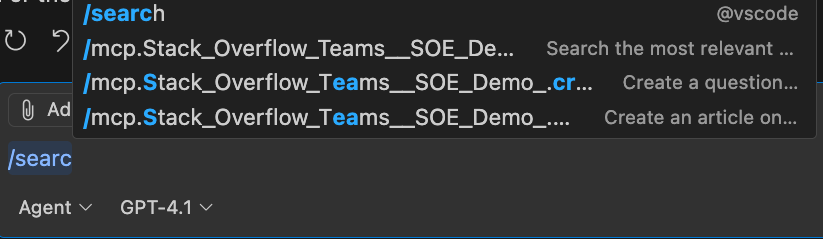
In addition to using natural language, you can invoke prompts by preceding them with the '/' character.
Prompt examples
How do I configure PKCE authentication?(invokes search prompt)/create_question "Error when connecting to remote MCP server"
Tools
The MCP server exposes the following tools to MCP clients. Clients can invoke tools through normal conversations with the agent, or through '#' commands.
| TOOL | DESCRIPTION |
|---|---|
search |
Find questions, answers, and articles by keyword. Returns titles, tags, and IDs. Use get_question or get_article for full content. |
get_question |
Retrieve a question with all its answers, authors, scores, and accepted status. |
get_article |
Retrieve a full article by ID. |
get_comments |
Read comments on a question or a specific answer. Read-only; creating comments requires the web UI. |
get_questions_to_answer |
Find questions without an accepted answer, filtered by topic or tag. Results may include questions that have answers but no accepted answer. |
get_existing_tags |
List all available tags with their IDs. Required before creating content. |
recommend_SME |
Find subject matter experts for a given tag based on Stack Internal activity. Takes a tag ID, so call get_existing_tags first. |
create_article |
Publish a knowledge article. Requires tags from get_existing_tags. |
create_question |
Post a new question. Requires tags from get_existing_tags. |
create_QA |
Post a question and answer pair. Requires tags from get_existing_tags. |
draft_question |
Draft a question for review without posting. Drafts are auto-tagged as ai-generated for provenance. |
submit_user_answer |
Post an answer to an existing question. |
update_answer |
Edit an existing answer. |
update_question |
Edit an existing question's title, body, or tags. |
vote |
Add or remove an upvote or downvote on a question or answer. |
Tool examples
How do I configure PKCE authentication?(invokes search tool)#get_question 3172
How it works
To use an analogy of building furniture, you can think of prompts as the directions and tools as your hammer and nails.
Prompts = Directions
Prompts are natural-language instructions your agent follows (for example: "Find related answers" or "Draft an article"). Prompts are great for everyday users in chat/IDE.
Tools = Hammer and Nails
Tools are the specific actions the agent can take (for example: search, create content, retrieve details). Tools are ideal when you're creating repeatable, automated workflows.
Prompts guide the work, and tools do the work.
You can control the default behavior of your agent, including how and when it invokes specific MCP tools, with an agent instructions file. Learn more in the MCP Server Agent instructions article.
Usage examples
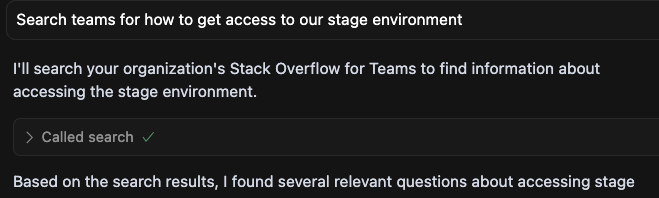
Agents will automatically invoke MCP server functions based on key words you use. The example below shows how the natural language prompt "Search teams..." caused the agent to invoke the search prompt.
You can also invoke prompts by preceding them with the '/' character.
You can explicitly invoke tools by preceding them with the '#' character.
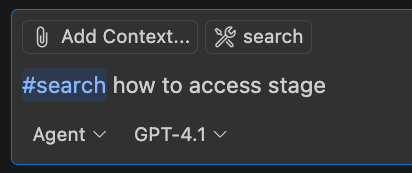
To verify that your client is connected, try a simple plain-text query such as Search Stack Internal for any content about [a topic your team covers].
For more usage examples, check out the MCP Server Use Cases article.
Next steps
This quickstart guide gets you started connecting to the MCP server. To unlock more features and capabilities, read the Stack Internal MCP server articles below.
Still have questions? Check out the MCP Server FAQ article.
If you're having problems accessing or using your MCP server, reach out to support.